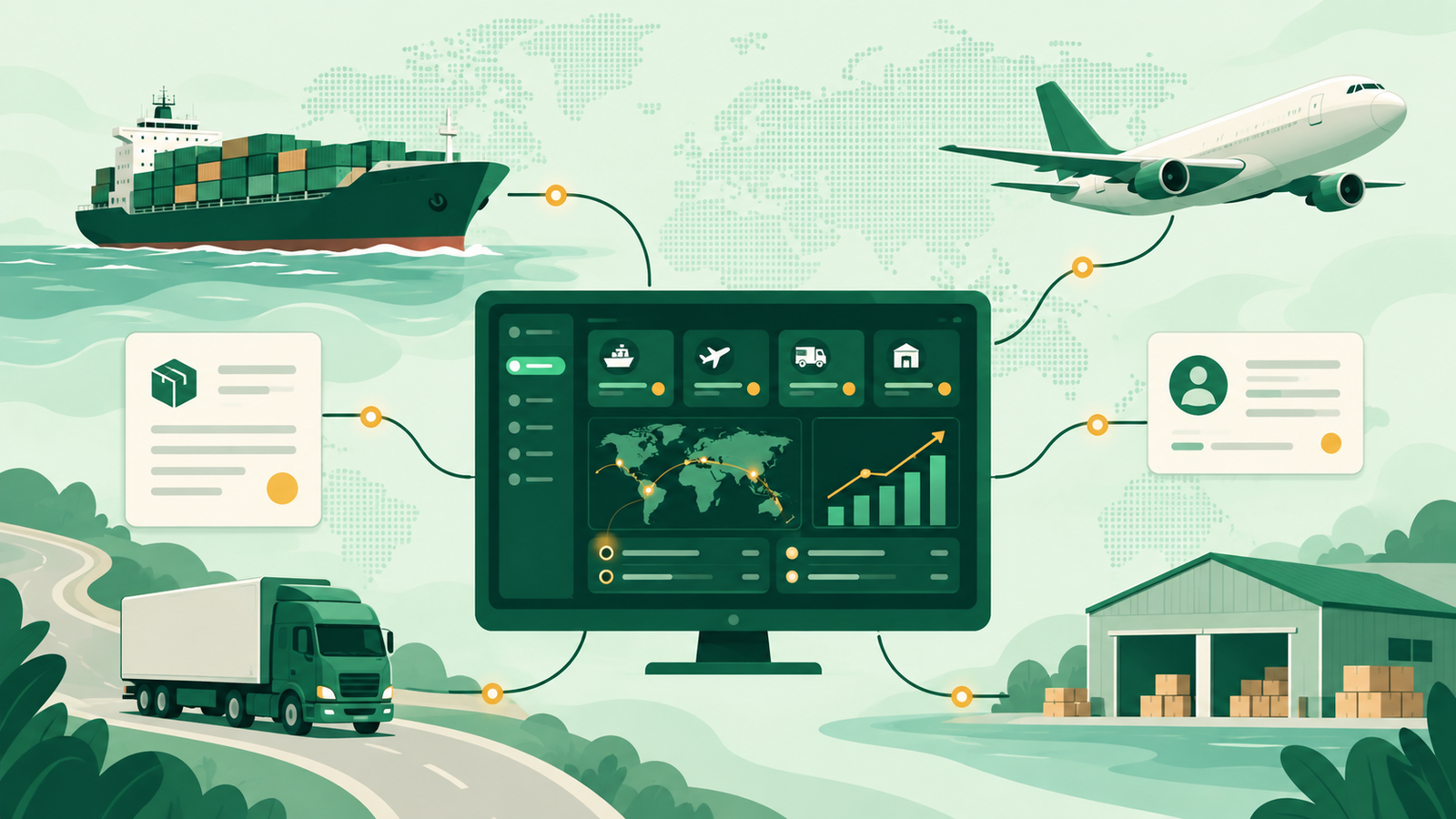
Freight forwarding software is difficult to compare because vendors use the same labels for very different products. One platform calls itself a transportation management system (TMS). Another uses freight management system (FMS). A third describes a similar workflow as logistics ERP or freight CRM.
The acronym is less important than the work the system owns.
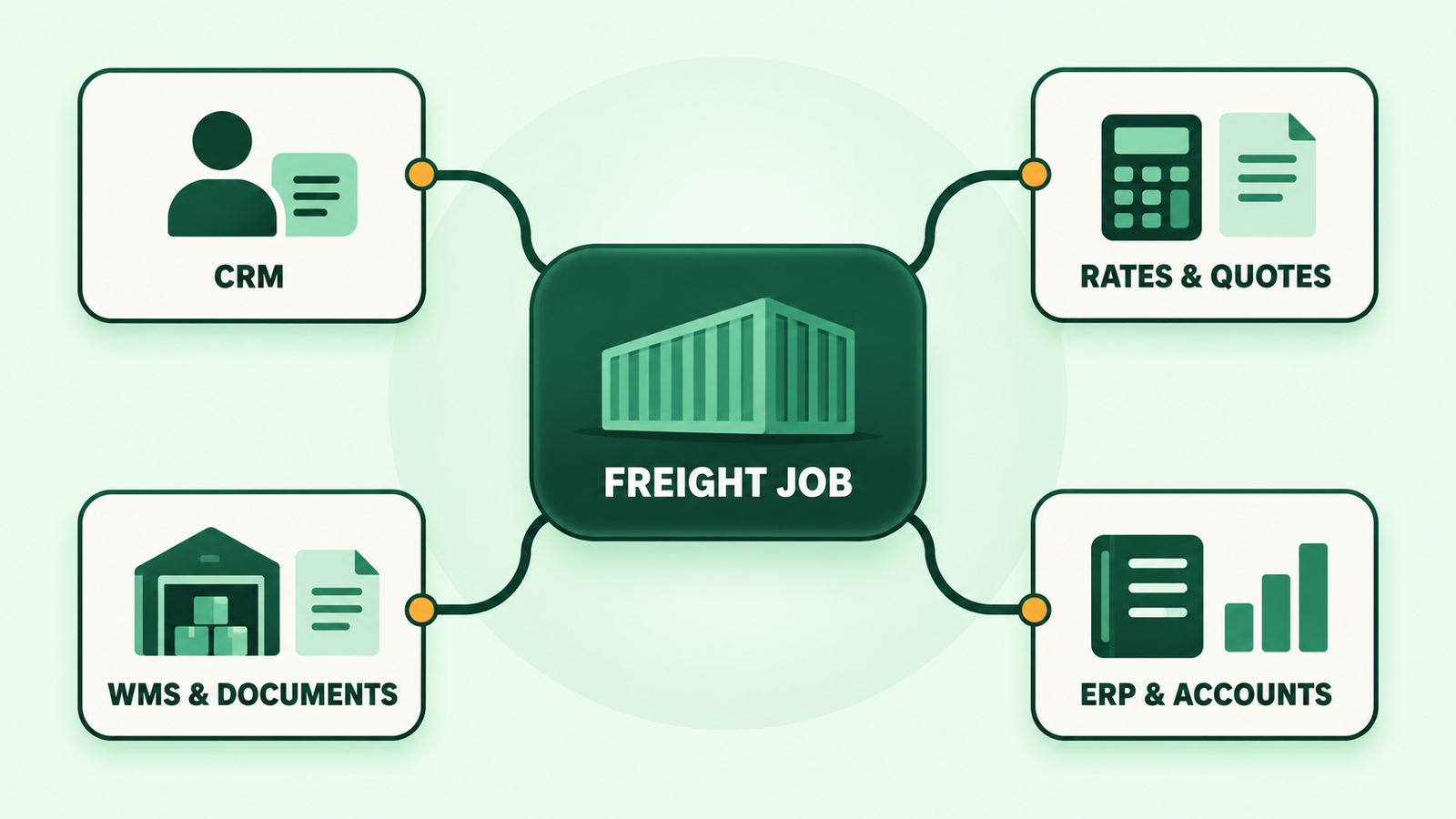
For a freight forwarder, the real test is whether customer, rate, quotation, shipment, document, invoice and job-profit data remain connected from the first inquiry to the final financial result. If ownership is unclear, teams rebuild the same record in email, spreadsheets and multiple applications.
Quick answer: Most freight forwarders need an FMS or forwarder-specific TMS as their operational core. CRM manages customer and sales activity, ERP or accounting software manages company-wide finance, WMS manages physical warehouse inventory, and specialist tools handle rates, quoting, visibility or documents. The right architecture depends on which system owns each record from inquiry to final job profit.
Why freight forwarding needs more than generic logistics software
Freight forwarding is broader than moving a truck from one point to another. FIATA's definition of freight forwarding covers carriage, consolidation, storage, handling, packing, distribution, customs and fiscal matters, insurance, documents, payments and related information technology.
That range explains why a forwarding business can accumulate several systems:
- a CRM for shippers, consignees, agents, leads and follow-ups;
- a rate or quotation tool for buying and selling prices;
- a TMS or FMS for bookings, jobs, routing, milestones and exceptions;
- document tools for bills of lading, air waybills and supporting records;
- a portal or visibility service for customer updates;
- accounting software for invoices, payments and the general ledger;
- a WMS when the business physically controls warehouse stock; and
- reporting or integration tools that reconcile data across the stack.
The problem is not having several tools. The problem is allowing several tools to become competing sources of truth.
The freight software stack at a glance
| Software category | The job it should own | Typical records | It should not be assumed to replace |
|---|---|---|---|
| CRM | Commercial relationship and sales follow-up | Companies, contacts, inquiries, activities, opportunities | Shipment execution or the general ledger |
| Rate and quotation software | Buying-rate control and customer quote creation | Rate cards, surcharges, validity, markup, quote versions | Complete job execution unless it is part of an FMS |
| TMS | Transport planning, execution and monitoring | Orders, loads, routes, carriers, milestones, freight costs | Forwarder-specific consolidation or documentation unless supported |
| FMS / forwarder TMS | The operational freight job | Booking, parties, cargo, routing, consolidation, milestones, documents | Warehouse inventory or enterprise finance unless supported |
| WMS | Stock inside a warehouse | Locations, receipts, picks, inventory, dispatches | International forwarding operations |
| ERP / accounting | Financial control across the company | Chart of accounts, invoices, payments, tax, cash and statutory reporting | Detailed freight execution unless a freight module exists |
| Visibility / portal | External status communication | Events, ETAs, exceptions, customer-facing updates | The authoritative operational job record |
These boundaries are not universal. An integrated suite may cover several categories. The point is to identify the authoritative owner of each record and the handoff between systems.
TMS explained: not every transportation system is built for a forwarder
Oracle defines a TMS as a logistics platform used to plan, execute and optimize the physical movement of goods. That definition is useful, but it includes multiple operating models.
A shipper TMS often focuses on tendering freight, selecting carriers, planning routes, controlling transport spend and monitoring inbound or outbound orders. A carrier TMS may focus on dispatch, vehicles, drivers, loads and proof of delivery. A freight-forwarder TMS must handle a different commercial and operational role: it buys transport from carriers, sells a forwarding service to customers, coordinates multiple parties, and may consolidate cargo across modes and countries.
When evaluating a TMS for forwarding, ask whether it can support:
- separate buying and selling charges;
- quotation revisions and validity;
- quote-to-booking conversion without re-entry;
- shipper, consignee, notify party, agent and carrier roles;
- ocean, air, road, courier or multimodal jobs as required;
- house and master document relationships;
- consolidations and deconsolidations;
- vendor bills, customer invoices and per-job gross profit; and
- office, currency, tax and permission controls.
A TMS that plans transport well may still be a poor operational core for a forwarder if those records live elsewhere.
FMS explained: the freight job as the operational core
Freight management system is another ambiguous label. In forwarding, it usually means the platform built around the freight job rather than around a vehicle or a shipper's transport order.
The freight job connects the commercial promise to execution. It should carry forward the customer, cargo, origin, destination, mode, routing, approved price and terms from the quotation. It then accumulates parties, milestones, documents, costs, customer charges, invoices and exceptions as the job progresses.
Some vendors call this a forwarder TMS. Others call it an FMS, logistics management platform or forwarding ERP. Do not decide from the label. Demonstrate the record lifecycle.
Where CRM fits—and where a generic CRM stops
CRM should own the relationship: which companies and people the forwarder serves, which inquiries are active, what has been quoted, who should follow up and what commercial history exists.
A generic CRM can do that well. The gap appears after a quote is accepted. If operations must copy the customer, cargo, route and price into a separate shipment system, the business creates a fragile handoff at the exact moment accountability changes from sales to operations.
A freight-specific CRM or a TMS with built-in CRM can keep that context attached to the job. It does not merely show that a deal was won; it shows what was promised, how the shipment is progressing, whether it was invoiced and whether it produced the expected margin.
For a deeper explanation, see how freight CRM connects customer, shipment and profit data. For vendor-selection intent, use the separate freight forwarding CRM comparison.
Rate and quotation software: from buying rates to an approved customer quote
Quotation speed is often treated as a document-generation problem. The harder part is rate control.
A useful freight quotation workflow may need to:
- capture the customer's route, cargo, mode and service requirements;
- request or retrieve buying rates from carriers and agents;
- normalize base freight, origin, destination and conditional surcharges;
- preserve validity dates, currencies, units and inclusions;
- apply markup and approval rules;
- issue a clear customer quotation with terms and exclusions;
- preserve every revision; and
- convert the accepted version into the operational job.
Rate management software may specialize in carrier contracts, spreadsheets, APIs or spot-rate requests. Quotation software may specialize in pricing and presentation. An FMS may combine both at a practical level. The critical question is whether the accepted commercial version becomes the controlled operational version.
This deserves its own future supporting article because searches for freight quotation software, freight rate management software and freight quote automation have a narrower and more urgent intent than the broad software-stack query.
Documents, customs references and compliance tools
Forwarding creates documents from data already captured elsewhere. Re-entering that data is slow and introduces inconsistent names, weights, routes and reference numbers.
Freight documentation software can generate or manage bills of lading, house and master air waybills, manifests, arrival notices, commercial invoices, packing lists and supporting files. But document generation is not the same as direct regulatory filing.
During a software demo, separate these questions:
- Can the system generate the document from structured job data?
- Can users control versions, approvals and attachments?
- Can it exchange standardized electronic data with partners?
- Does it file directly with the required customs, port or aviation authority in the countries where you operate?
IATA's e-freight program emphasizes electronic messages, data quality and removal of paper documents in air cargo. FIATA's digital strategy likewise highlights interoperability. A system can support good digital documentation without supporting every external filing connection, so verify each integration rather than assuming it.
Tracking and customer portals are separate capabilities
“Tracking” can mean at least three things:
- Recorded milestones: users update booked, departed, arrived, customs-cleared and delivered events in the operational job.
- External event feeds: carriers, airlines, terminals or visibility providers send status data into the platform.
- Customer visibility: a portal or notification workflow exposes approved status information to the customer.
A portal without a reliable job record only displays inconsistent data more attractively. An external feed without ownership and exception rules can create noise. The forwarder's operational system should decide which events matter, who owns the next action and what the customer is allowed to see.
Freight accounting and job costing: where operational truth becomes financial truth
A forwarder can execute a shipment successfully and still lose margin through missed charges, late vendor invoices or an incorrect quote version.
Freight accounting and job-costing software should connect:
- customer selling charges;
- expected and actual vendor costs;
- sales and purchase invoices;
- receipts and payments;
- receivables and payables;
- taxes and currencies;
- accruals or unbilled costs where required; and
- gross profit by job, customer, route, mode or office.
These values are related but not interchangeable. Revenue is not cash collected. Gross profit is not net profit. An operational estimate is not the final result after all costs arrive.
Whether accounting is built into the FMS or integrated with a separate package depends on regulatory needs, finance-team preference and product depth. Either model can work if ownership is explicit and reconciliation is controlled.
Which system should own each record?
This is the most useful exercise in a freight software evaluation. Name one authoritative owner for every important record, then list which other systems may read or update it.
| Record | Recommended owner | Other consumers | What fails when ownership is unclear |
|---|---|---|---|
| Company and contact | CRM or integrated FMS | Quoting, operations, finance | Duplicates, conflicting credit or address data |
| Customer inquiry | CRM or integrated FMS | Rate desk, sales reporting | Missed RFQs and weak follow-up accountability |
| Buying rate | Rate system or FMS | Quotation | Expired rates, missing surcharges, inconsistent units |
| Quotation | Quoting system or FMS | CRM, operations, finance | Wrong version or margin reaches the job |
| Booking / freight job | FMS or forwarder TMS | Portal, documents, finance | Teams disagree on route, parties or current status |
| Shipment document | FMS / document system | Customer portal, compliance archive | Retyping, version errors and missing audit trail |
| Warehouse stock | WMS | FMS, billing, customer portal | Inventory and shipment quantities diverge |
| Customer invoice | Accounting or finance-capable FMS | CRM, reporting, portal | Revenue, tax and receivable mismatches |
| Vendor bill | Accounting or finance-capable FMS | Job costing, AP | Final job cost arrives late or is allocated incorrectly |
| General ledger | ERP / accounting | Management reporting | Statutory accounts do not reconcile to operations |
| Job profit | Calculated from controlled sales and cost records | Management, sales, finance | Margin reports change depending on the screen used |
The cleanest architecture is not necessarily one database. It is one agreed owner per record, predictable synchronization and a visible recovery process when an integration fails.
One integrated suite or a connected best-of-breed stack?

Continuity firstIntegration ownership
An integrated suite is usually stronger when
- the team repeatedly re-enters the same data;
- commercial handover is the main failure point;
- job costing must stay close to operations;
- the business has limited internal IT capacity;
- consistent permissions and reporting matter more than specialist depth; or
- a small or mid-sized forwarder wants one accountable implementation partner.
A connected specialist stack is usually stronger when
- the company already has a mature ERP or CRM that cannot be replaced;
- a specialist rate, customs, warehouse or visibility capability is essential;
- internal teams can own integrations and data governance;
- regional operations require different statutory systems; or
- the operational gain from a specialist tool exceeds the integration cost.
The hidden cost of best-of-breed is not only the connector. It is deciding what happens when a record is changed in both systems, an API is unavailable, a user merges duplicates, or a mapping rule stops working. The hidden cost of an integrated suite is compromise: one module may not match a specialist product's depth.
Choose software from the bottleneck, not the acronym
Start with the failure that creates the most commercial or operational risk.
| Current bottleneck | Capability to evaluate first |
|---|---|
| RFQs disappear in personal inboxes | CRM and structured inquiry intake |
| Rates are scattered across spreadsheets | Rate management and validity control |
| Quotes are slow or inconsistent | Quotation workflow and approvals |
| Accepted quotes are typed into a second system | Integrated quote-to-job conversion |
| Staff retype document details | Structured freight documents |
| Customers call for routine status updates | Milestone control and customer portal |
| Late costs erase expected margin | Job costing, AP and unbilled-cost control |
| Offices report different numbers | Shared ownership rules and multi-office reporting |
| Warehouse stock and shipment records disagree | WMS integration and item-level reconciliation |
This approach keeps a software project tied to a measurable operational outcome without assuming that one product category solves every problem.
How to evaluate freight forwarding software with one real scenario
Feature checklists are easy to satisfy in a presentation. A live scenario exposes whether the workflow is actually connected.
Ask each vendor to demonstrate the same representative job:
1. Capture a realistic inquiry
Use a real lane and cargo profile with shipper, consignee, mode, dimensions, weight, Incoterm, requested schedule and a missing detail that sales must follow up.
2. Build and revise the quotation
Enter two buying options, local charges, a currency conversion, a markup and an approval rule. Then revise one surcharge and confirm that the original version remains auditable.
3. Convert the accepted quote into a job
No one should retype the customer, parties, cargo, route or approved charges. Confirm which information becomes locked and what operations can change.
4. Execute and document the shipment
Create the required house/master document structure, add milestones, attach a file and record an exception. For a multimodal forwarder, repeat the critical parts for both ocean and air.
5. Invoice and close the financial result
Add a late vendor cost after the customer invoice is drafted. Confirm how the system warns users, updates expected versus actual margin, handles receivables/payables and reports final job profit.
Also test data export, role permissions, office separation, currencies, audit history and what happens when an integration fails.
Software for a small freight forwarding company
Small forwarders do not necessarily need fewer capabilities. They often need less administration.
A practical small-business system should make the core workflow usable without a dedicated implementation department. Prioritize:
- clear inquiry and quotation ownership;
- fast quote-to-job conversion;
- the modes and documents the business actually handles;
- customer and vendor balances;
- job-level cost and margin visibility;
- reliable exports and backups;
- permissions that can grow with the team; and
- support that covers configuration and migration, not only bug reports.
Avoid buying enterprise breadth for hypothetical future services while the current quote-to-cash process remains fragmented. Equally, avoid a cheap point tool that creates another re-entry step at the busiest handoff.
Where Waybill CRM fits
Disclosure: Syntropy develops Waybill CRM. This section describes its public product scope; it is not an independent ranking.
Waybill CRM is designed as a connected freight-forwarding workspace. Its public workflow covers customer inquiries, buying-rate requests, quotations, conversion into freight jobs, air/sea/courier shipment records, operational documents, customer and vendor activity, invoices, receivables, payables and job-level margin reporting.
That makes it most relevant to forwarding teams whose main problem is fragmentation from inquiry through billing. It should not be assumed to replace a warehouse management system, every country-specific customs filing product, or every external carrier integration. Those requirements should be confirmed against the specific implementation.
For implementation evidence, Transparent Freight Services reports that documentation previously taking 30–40 minutes per job is now completed in under one minute after its Waybill deployment. That is a customer-reported result from one implementation, not a universal performance guarantee.
The practical decision
The best freight forwarding software is not the product with the longest feature list. It is the architecture that keeps the right records connected and makes accountability obvious.
Before choosing a CRM, TMS, FMS, ERP or specialist tool, answer five questions:
- Which system owns the customer?
- Which system owns the accepted quote?
- Which system owns the operational freight job?
- Which system owns the invoice and vendor cost?
- Where is the final job profit calculated and reconciled?
If those answers require several spreadsheets or depend on one employee's memory, the software stack has an ownership problem. Fixing that map is the first step toward a cleaner implementation.
Book a Waybill CRM workflow demo to test the inquiry-to-margin process against a real shipment from your operation.
Frequently asked questions
Is an FMS the same as a freight-forwarder TMS?
Sometimes. Vendors use the labels differently. A forwarder-focused TMS and an FMS may cover the same operational core: quotations, bookings, freight jobs, parties, routing, documents, milestones, charges and job profit. Verify the record lifecycle instead of relying on the acronym.
What is the difference between a shipper TMS and a forwarder TMS?
A shipper TMS usually helps a cargo owner plan, procure and monitor transportation. A forwarder TMS must also manage the service the forwarder sells, including buying and selling charges, multiple parties, house/master relationships, consolidation and per-job profitability.
Does a freight forwarder need both CRM and TMS?
It needs both customer relationship control and shipment execution capability. Those functions may live in two integrated products or in one forwarder-specific platform. The important requirement is a controlled handoff from inquiry and accepted quote into the operational job.
Can a generic CRM replace freight forwarding software?
A generic CRM can manage accounts, contacts, sales activities and opportunities. It normally does not replace freight jobs, consolidation, shipment documents, milestones, vendor costs, invoices or job-level profit unless those workflows are added through customization or integrations.
Should freight accounting be built in or integrated?
Either model can work. Built-in accounting can keep operations, charges and job costing close together. A separate accounting or ERP system may offer stronger statutory, tax or group-finance capabilities. Define which system owns invoices, payments, the general ledger and final job profit, then test reconciliation.
Does freight forwarding software include WMS features?
Not automatically. Some suites include warehouse modules, while others integrate with a WMS. If the business stores and controls physical inventory, verify locations, receipts, picks, stock adjustments and dispatch workflows separately from shipment management.
What should a small forwarder test first?
Use one real customer inquiry and carry it through rates, quotation, approval, freight job, document, vendor cost, customer invoice and final margin. That single scenario reveals more than a generic feature checklist.
How should a forwarder prepare for implementation?
Clean customer and vendor records, define status and document standards, identify open jobs, decide which historical data must migrate, assign one owner to each key record and agree how finance will reconcile opening balances. Configuration decisions usually matter as much as data import.
Sources and methodology
This guide was prepared from Syntropy's public product documentation and direct workflow experience, current competitor and search-result analysis, and authoritative industry definitions. Key external references include FIATA's definition of freight forwarding, FIATA's digital strategy, Oracle's TMS overview and IATA's e-freight program.